Hiring a commercial cleaning company is one thing. Knowing exactly what your cleaning service should include is another. A proper commercial cleaning checklist helps Grande Prairie business owners understand which areas need attention, what tasks should be part of regular janitorial service, and how to evaluate the quality of the work.
From reception desks and employee workstations to washrooms, kitchens, and high-traffic floors, every part of your workplace has different cleaning requirements.
A clean-looking office is a good start, but professional commercial cleaning should also address hygiene, waste management, surface care, and the details that employees and customers notice.
At AquaMaid Ltd., we provide commercial and office cleaning services in Grande Prairie, Alberta, using customized cleaning plans supported by our AquaFresh Quality Control Process.
This guide breaks down what a commercial cleaning service should include, room by room. It also explains which services may require additional attention and provides a sample inspection checklist that business owners can use to assess their current cleaning arrangements.
Quick Answer: What Should a Commercial Cleaning Service Include?
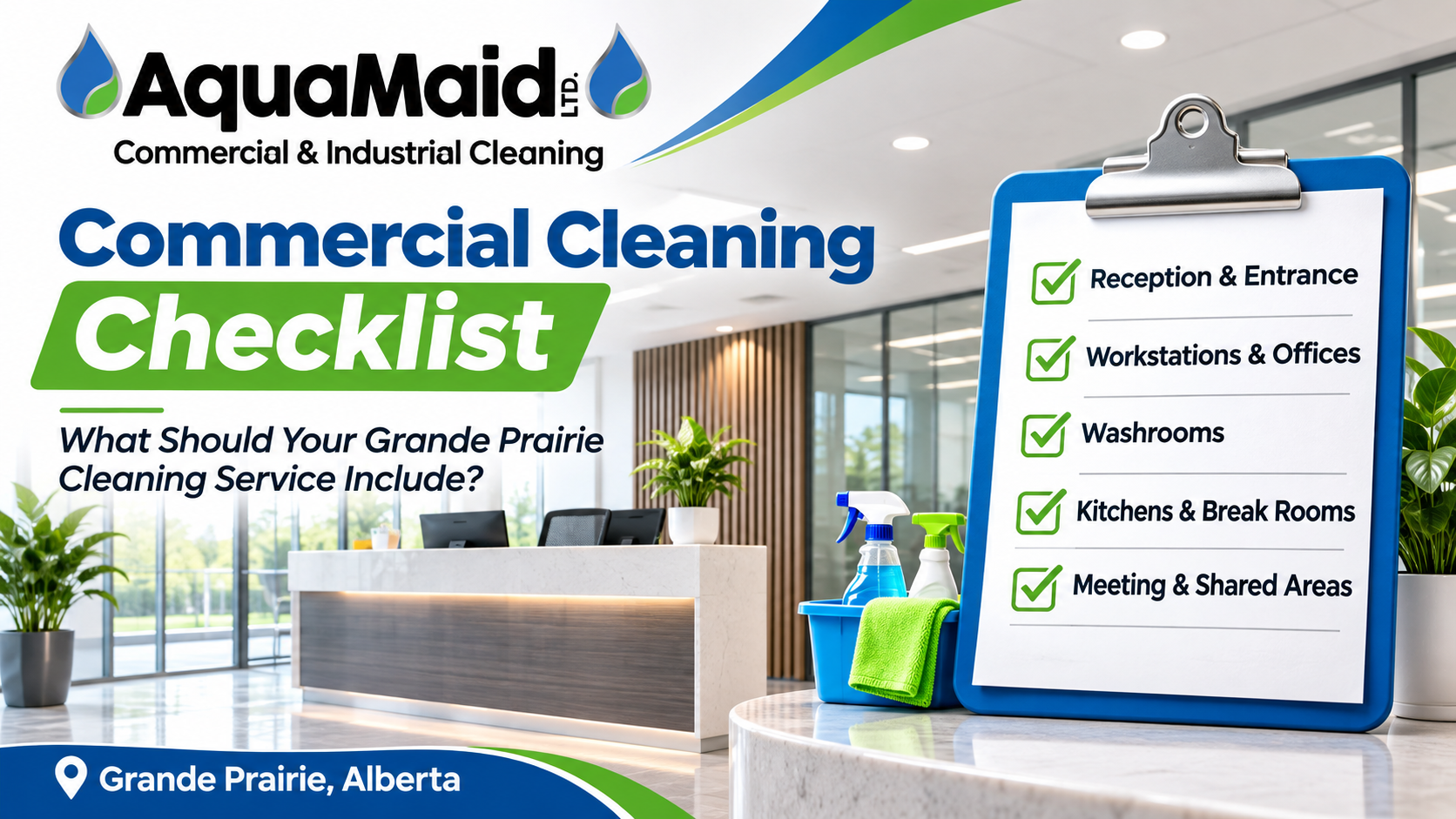
A standard commercial cleaning service typically covers the following areas:
- Reception and entrance areas: Cleaning entry doors, reception counters, waiting areas, entrance mats, and floors.
- Offices and workstations: Dusting accessible surfaces, cleaning desks and shared equipment, vacuuming, and emptying garbage bins.
- Washrooms: Cleaning toilets, sinks, mirrors, countertops, dispensers, floors, and frequently touched surfaces.
- Kitchens and break rooms: Cleaning countertops, sinks, appliance exteriors, tables, floors, and waste containers.
- Meeting rooms and shared spaces: Cleaning tables, chairs, switches, door handles, and other frequently used surfaces.
- Hallways, stairways, and common areas: Vacuuming, mopping, removing visible marks, and cleaning handrails.
- Waste and recycling: Emptying bins, replacing liners where required, and transferring waste to designated collection areas.
- High-touch surfaces: Cleaning and, when appropriate, disinfecting door handles, switches, counters, railings, and shared equipment.
Additional services such as carpet extraction, floor stripping and waxing, tile restoration, and detailed post-construction cleaning may require separate arrangements.
The exact services included should always be documented in your cleaning agreement.
1. Reception and Entrance Cleaning Checklist
Your entrance and reception area is often the first part of your business that customers, employees, and visitors see.
A dirty entrance, dusty counter, or visibly marked floor can create a poor impression before anyone has spoken to your team.
For businesses in Grande Prairie, entrances also face additional challenges during winter and spring. Snow, mud, sand, and de-icing materials can accumulate quickly as people move between parking areas and indoor spaces.
Reception and Entrance Cleaning Tasks
A commercial cleaning checklist for reception areas should include:
- Clean and wipe down reception desks and countertops.
- Dust accessible furniture, shelves, and decorative surfaces.
- Clean entrance door handles and push plates.
- Remove fingerprints and smudges from accessible glass doors.
- Clean frequently touched reception surfaces.
- Vacuum entrance mats and carpeted areas.
- Sweep and mop hard-surface flooring using suitable products.
- Remove visible dirt, sand, and debris near entrances.
- Clean waiting room tables and accessible seating surfaces.
- Empty reception garbage and recycling bins.
- Spot-clean visible marks on doors and washable surfaces.
- Check for spills, slippery areas, or other visible floor concerns.
What should you look for after cleaning?
Your reception area should look presentable when the business opens. Glass should be free of obvious fingerprints, floors should not have visible dirt or sticky residue, and waiting areas should be tidy.
For Grande Prairie workplaces, entrance mats and flooring deserve particular attention during periods of snow and slush.
A clean entrance also helps limit the amount of dirt tracked into offices, hallways, and meeting rooms.
2. Office Workstations and Desk Cleaning Checklist
Office workstations collect dust, crumbs, fingerprints, and everyday debris.
However, cleaning personal workspaces requires care. Employees may have confidential documents, expensive equipment, personal belongings, and electronic devices on their desks.
A professional cleaning plan should clearly define which surfaces can be cleaned and which areas should remain untouched.
Office and Workstation Cleaning Tasks
- Empty designated individual office garbage bins.
- Replace garbage liners where required.
- Dust accessible, cleared desk surfaces.
- Wipe down approved work surfaces.
- Clean shared desks and worktables.
- Dust accessible shelving, cabinets, and window ledges.
- Clean fingerprints from cabinet handles and door handles.
- Vacuum carpeted areas, including accessible spaces beneath desks.
- Sweep and mop appropriate hard floors.
- Spot-clean visible marks on washable doors and surfaces.
- Clean light switches and other frequently touched fixtures.
- Clean approved shared telephones, keyboards, and computer accessories using equipment-safe methods.
What About Computers and Electronics?
Not every commercial cleaning contract includes detailed electronic equipment cleaning.
Computers, monitors, keyboards, and sensitive equipment require appropriate products and handling procedures.
Before cleaning, your business and cleaning contractor should establish clear instructions about:
- Which electronic devices can be touched.
- Which cleaning products are approved.
- How shared equipment should be handled.
- Which desks must remain undisturbed.
- How confidential paperwork should be protected.
A professional cleaner should never need to reorganize confidential documents or move sensitive equipment to perform routine cleaning.
For accounting firms, insurance offices, legal practices, and other professional workplaces, these boundaries are particularly important.
3. Commercial Washroom Cleaning Checklist
Washrooms are among the most important areas of any commercial cleaning program.
Employees and customers expect washrooms to be clean, sanitary, stocked, and properly maintained.
Unlike general office dusting, washroom cleaning involves surfaces that require specific sanitation procedures and attention to cross-contamination.
Washroom Cleaning Tasks
- Clean and disinfect toilet seats, bowls, lids, and exterior surfaces.
- Clean toilet flush handles and buttons.
- Clean and disinfect urinals where present.
- Clean sinks and faucets.
- Wipe countertops and surrounding surfaces.
- Clean mirrors to remove fingerprints and water spots.
- Clean soap dispensers and frequently touched fixtures.
- Clean stall doors, handles, and locks.
- Empty waste and sanitary disposal bins according to the agreed procedure.
- Replace garbage liners where required.
- Refill toilet paper, soap, and paper towels if included in the contract.
- Clean dispensers and check that they operate correctly.
- Sweep and mop floors using suitable washroom cleaning products.
- Clean accessible floor edges and corners.
- Remove visible splashes and marks from washable surfaces.
- Check for unpleasant odours, leaks, damage, or maintenance concerns.
What Should a Properly Cleaned Washroom Look Like?
A cleaned washroom should have:
- No visible residue on toilets, sinks, or countertops.
- Clean mirrors and fixtures.
- Floors free of visible dirt, hair, and debris.
- Waste containers that have been emptied as required.
- Adequate consumable supplies.
- No obvious cleaning product residue.
- No neglected areas around toilet bases, corners, and accessible fixtures.
Alberta's Occupational Health and Safety Code, Part 24, includes requirements for workplace toilet facilities, hand-cleaning supplies, and the cleanliness and sanitary condition of washrooms and lunchrooms.
A commercial cleaning company can support these responsibilities, but employers remain responsible for maintaining compliant workplace facilities.
Cleaning vs. Disinfecting
Cleaning and disinfecting are related, but they serve different purposes.
Cleaning removes visible dirt, dust, debris, and residues.
Disinfecting uses an appropriate product to reduce or destroy targeted microorganisms on suitable surfaces.
Disinfection works best when surfaces have first been cleaned. The disinfectant must be used according to its label instructions, including any required surface contact time.
For washrooms, the cleaning process should use tools and cloths that prevent contamination from spreading into kitchens, desks, or other areas.
4. Office Kitchen and Break Room Cleaning Checklist
Shared kitchens and lunchrooms experience frequent use throughout the workday.
Coffee spills, crumbs, food residue, dirty counters, and overflowing garbage can quickly make these areas unpleasant.
A professional commercial cleaning service should address the surfaces employees use for food preparation, eating, and shared breaks.
Kitchen and Break Room Cleaning Tasks
- Clean countertops and accessible food preparation surfaces.
- Clean sinks and faucets.
- Wipe tables, counters, and shared seating surfaces.
- Clean microwave exteriors and accessible control panels.
- Wipe refrigerator doors and handles.
- Clean coffee station surfaces and appliance exteriors.
- Remove visible crumbs and food residue.
- Clean accessible cabinet handles.
- Empty garbage, recycling, and designated compost bins.
- Replace liners as required.
- Sweep and mop floors.
- Spot-clean spills and visible marks.
- Clean frequently touched switches and door handles.
- Check that food waste has been removed from designated waste containers.
Is Cleaning Inside Appliances Included?
Not necessarily.
Routine commercial cleaning usually addresses accessible surfaces and appliance exteriors.
Detailed work inside refrigerators, microwaves, ovens, and other equipment may be included in a customized agreement or arranged separately.
For example, a business might request:
- Interior refrigerator cleaning.
- Microwave interior cleaning.
- Cleaning of cupboard interiors.
- Removal of expired food, subject to staff authorization.
- Detailed appliance degreasing.
- Cleaning behind movable appliances.
These tasks should be specified before work begins.
Important: Food-contact surfaces require products and procedures appropriate for their intended use. Cleaning chemicals should never leave unsafe residues on surfaces where food is prepared.
5. Meeting Rooms and Conference Room Cleaning Checklist
Meeting rooms often receive less attention than reception areas and washrooms.
However, they are regularly used by employees, managers, customers, and visitors.
Meeting tables can accumulate fingerprints, beverage marks, dust, and food residue. Shared equipment may also be touched by multiple users.
Meeting Room Cleaning Tasks
- Wipe down conference tables.
- Clean accessible chairs and armrests.
- Dust shelves, ledges, and furniture.
- Clean door handles and light switches.
- Remove fingerprints from accessible glass partitions.
- Clean approved shared equipment and control surfaces.
- Empty garbage and recycling containers.
- Vacuum carpets and area rugs.
- Sweep and mop hard floors.
- Spot-clean visible spills and marks.
- Return approved movable furniture to its designated position.
- Check the room for obvious missed cleaning tasks.
Why Meeting Room Cleaning Matters
A meeting room can appear clean from the doorway while still having sticky tables, dirty chairs, and dusty surfaces.
A cleaning inspection should consider what people see and touch when they actually use the room.
The goal is simple: your meeting room should be ready for the next scheduled meeting without employees having to clean it first.
6. Hallways, Stairwells, and Common Area Cleaning Checklist
Hallways and shared areas connect every part of your workplace.
Because employees and visitors move through these areas regularly, dirt and debris can spread from entrances into surrounding rooms.
Commercial cleaning should address floors, handrails, doors, and commonly touched surfaces throughout the building.
Hallway and Shared Area Cleaning Tasks
- Vacuum carpeted hallways.
- Sweep and mop hard-surface hallways.
- Clean visible dirt and debris from accessible floor edges.
- Wipe frequently touched door handles.
- Clean stairway handrails.
- Clean reachable elevator buttons and approved control surfaces.
- Spot-clean fingerprints from accessible glass.
- Dust accessible windowsills and ledges.
- Remove cobwebs from reachable locations.
- Clean designated common-area waste containers.
- Check for visible spills and slip hazards.
- Report damaged flooring or other maintenance concerns.
Stairwell Cleaning Requires Extra Attention
Stairwells are often overlooked because they do not receive the same attention as offices or customer-facing areas.
However, dirty steps, accumulated debris, and residue on hard flooring can create avoidable problems.
A proper commercial cleaning checklist should include stair treads, accessible corners, landings, and handrails.
Where necessary, cleaning crews should use appropriate signage and procedures while floors are wet.
7. Commercial Floor Cleaning Checklist
Floors often represent one of the largest cleaning challenges in a commercial building.
Unlike desks and countertops, flooring experiences constant wear from employees, customers, furniture, and equipment.
Grande Prairie workplaces face additional seasonal challenges from snow, gravel, mud, and de-icing residue.
Different flooring materials also require different cleaning methods.
Routine Commercial Floor Cleaning Tasks
- Vacuum carpeted traffic areas.
- Vacuum accessible corners and edges.
- Sweep hard flooring.
- Mop suitable hard flooring using approved products.
- Remove loose dirt and debris.
- Spot-clean accessible floor spills and marks.
- Clean around furniture and fixtures where safely accessible.
- Clean entrance mats and surrounding floor areas.
- Check for sticky residue and visible streaking.
- Report floor damage, loose tiles, or other safety concerns.
Carpeted Offices
Carpets collect dust, tracked-in grit, and everyday debris.
Routine vacuuming helps manage loose soil, particularly around entrances, workstations, and shared walkways.
However, vacuuming cannot remove every embedded stain or accumulated residue.
Periodic carpet extraction may be necessary to maintain appearance and address deeper soil buildup.
Vinyl and VCT Flooring
Vinyl composition tile, commonly called VCT, is used in many commercial buildings.
Routine maintenance may include dust removal and damp mopping with compatible products.
Depending on the floor's condition and finish, additional work may involve stripping old finish, applying new coats, or polishing.
Tile and Grout
Tile flooring is common in washrooms, kitchens, and high-traffic areas.
Routine mopping maintains the tile surface, but grout can gradually collect dirt and discoloration.
Detailed tile and grout cleaning may require specialized equipment and products.
Why Grande Prairie Businesses Need a Seasonal Floor Care Plan
Winter can place additional demands on commercial flooring.
Snow, moisture, sand, and de-icing residue enter buildings through footwear and equipment.
Without proper maintenance, these materials may contribute to:
- Visible staining.
- Dull floor finishes.
- Increased carpet soiling.
- Dirt buildup along floor edges.
- Slippery entrance areas.
- Additional wear on floor coverings.
For businesses with heavy entrance traffic, professional floor cleaning should be adapted to actual building conditions.
AquaMaid offers specialized commercial floor care services, including carpet extraction, stripping and waxing, buffing and polishing, and tile and grout care.
8. Garbage, Recycling, and Waste Management Checklist
Waste removal is a basic part of commercial janitorial service, but expectations should still be clearly defined.
In larger workplaces, cleaning staff may be responsible for dozens of waste containers across offices, kitchens, washrooms, and shared areas.
Waste Management Tasks
- Empty designated office garbage bins.
- Empty reception and waiting room bins.
- Empty kitchen waste containers.
- Empty washroom bins.
- Collect designated recycling.
- Replace bin liners where required.
- Wipe visible residue from accessible bin exteriors.
- Report leaking or damaged waste containers.
- Transport waste to approved collection areas.
- Follow the facility's sorting and disposal instructions.
- Leave waste collection areas tidy.
What About Specialized Waste?
Not all waste should be handled under a standard commercial cleaning agreement.
Medical waste, sharps, hazardous materials, chemicals, and other regulated materials may require specific procedures and authorized collection services.
Businesses should clearly identify these materials and establish separate handling arrangements when required.
For ordinary offices, your cleaning contract should specify which bins are included and where collected waste must be placed.
9. Additional Commercial Cleaning Services: What Is Usually Extra?
One of the most common sources of confusion in commercial cleaning contracts is the difference between regular janitorial work and periodic deep cleaning.
Routine cleaning maintains the everyday condition of your workplace.
Specialized services address buildup, restoration, difficult surfaces, and tasks requiring additional equipment or labour.
The following table can help business owners distinguish between the two.
| Regular Janitorial Cleaning | Specialized or Additional Cleaning |
|---|---|
| Routine carpet vacuuming | Deep carpet cleaning and extraction |
| Sweeping and mopping floors | Floor stripping and waxing |
| General floor maintenance | Machine buffing and polishing |
| Routine tile mopping | Detailed tile and grout restoration |
| Wiping appliance exteriors | Detailed appliance interior cleaning |
| Accessible surface dusting | High-level dusting requiring special access |
| Spot-cleaning accessible glass | Full interior or exterior window cleaning |
| Routine washroom sanitation | Detailed grout, scale, or buildup removal |
| Regular office cleaning | Post-construction cleaning |
| Accessible furniture wiping | Upholstery deep cleaning |
These are common distinctions, not universal rules. Your written service agreement determines what is included.
Carpet Extraction
Professional carpet extraction removes embedded soil using specialized equipment and an appropriate cleaning process.
It can be useful for:
- High-traffic commercial offices.
- Reception and waiting areas.
- Carpeted meeting rooms.
- Businesses experiencing substantial winter dirt accumulation.
- Workplaces with visibly stained carpeting.
Floor Stripping and Waxing
Some commercial floor finishes require periodic stripping and reapplication.
This process removes old floor finish and allows a new protective finish to be applied to suitable flooring.
It is different from routine mopping and should be handled according to the floor manufacturer's recommendations.
Buffing and Polishing
Machine buffing and polishing can help restore the appearance of certain commercial floors.
The method depends on the floor material and the existing finish.
Tile and Grout Restoration
Regular cleaning addresses everyday surface dirt, but heavily soiled grout and textured tile may require more intensive treatment.
AquaMaid provides professional tile and grout cleaning services for suitable flooring systems.
Post-Construction Cleaning
After renovations or construction, a building may require specialized cleanup to remove construction dust, residue, and debris.
This typically falls outside normal recurring office cleaning.
AquaMaid also provides post-construction and post-renovation cleanup services in Grande Prairie.
10. Commercial Cleaning Requirements for Different Types of Businesses
Not every business requires the same cleaning specifications.
A small accounting office, medical clinic, warehouse, and retail store have different surfaces, equipment, and operational requirements.
A well-designed commercial cleaning checklist should reflect those differences.
Professional and Administrative Offices
These workplaces typically prioritize:
- Workstations and desks.
- Reception areas.
- Meeting rooms.
- Shared kitchens.
- Washrooms.
- Carpets and common areas.
- Confidentiality and care around office equipment.
Medical and Dental Offices
Medical and dental facilities may require additional infection prevention and control procedures.
These can involve:
- Facility-approved disinfectants.
- Defined cleaning responsibilities.
- Appropriate handling of contaminated materials.
- Cleaning procedures for designated clinical spaces.
- Additional documentation and specialized staff training.
Routine commercial janitorial service should not be assumed to cover every clinical or infection-control requirement.
AquaMaid provides cleaning services for medical and dental offices, with plans adapted to each facility's requirements.
Retail Stores and Customer-Facing Businesses
Retail cleaning often focuses on:
- Entrances and customer traffic areas.
- Checkout counters.
- Display fixtures.
- Fitting rooms.
- Accessible glass.
- Public washrooms.
- Frequently touched surfaces.
- Floor appearance.
Warehouses and Industrial Facilities
Industrial spaces may need cleaning procedures that account for:
- Warehouse floors and walkways.
- Tracked-in dirt and industrial dust.
- Employee lunchrooms and washrooms.
- Administrative offices.
- Designated staff areas.
- Site-specific safety procedures.
- PPE and WHMIS requirements where applicable.
Industrial cleaning should account for equipment access, operating schedules, and the risks associated with an active worksite.
AquaMaid offers industrial cleaning services for Grande Prairie warehouses and other commercial facilities.
11. How Can You Tell if Your Commercial Cleaning Company Is Doing a Good Job?
A cleaning checklist becomes much more useful when it is connected to a quality-control process.
Without clear expectations, one person may consider a room clean while another sees several missed tasks.
Business owners should be able to answer three basic questions:
- What work was supposed to be completed?
- Was that work completed to the agreed standard?
- How are missed tasks identified and corrected?
A written cleaning scope and documented inspections help answer these questions.
Common Signs That Cleaning Quality Needs Attention
Look for problems such as:
- Garbage bins regularly left full.
- Dust remaining on accessible furniture and ledges.
- Washroom fixtures with visible residue.
- Dirty mirrors or glass doors.
- Carpet corners that appear consistently neglected.
- Sticky kitchen countertops.
- Repeated stains or debris in common areas.
- Entrance floors that remain dirty after service.
- Missed consumable refills where restocking is included.
- Recurring complaints about the same areas.
One missed item does not necessarily indicate a failing cleaning service.
However, repeated problems suggest that the cleaning checklist, supervision, or inspection process may need improvement.
12. AquaMaid's AquaFresh Quality Control Process
At AquaMaid, we believe commercial cleaning should come with clear expectations and accountability.
That is why we developed our AquaFresh Quality Control Process.
Our cleaning services are supported by a dedicated quality-control specialist who operates separately from the cleaning crew.
This creates an additional layer of inspection beyond the initial cleaning work.
How the AquaFresh Process Supports Consistent Cleaning
Step 1: Establish a Customized Cleaning Plan
Every business has different requirements.
We identify the spaces that require attention and develop a cleaning checklist based on the facility, surfaces, priorities, and agreed scope of work.
Step 2: Complete the Scheduled Cleaning Tasks
Our cleaning crew works through the assigned areas using the cleaning plan developed for the property.
This provides a consistent reference for the work expected during each service.
Step 3: Conduct a Quality-Control Inspection
A dedicated quality specialist reviews the completed work separately from the cleaning crew.
The inspection focuses on the cleanliness of the workspace and the requirements established for the client.
Step 4: Document Missed Items and Opportunities for Improvement
Our quality-control process includes an inspection log to record cleaning issues and areas requiring attention.
This helps identify recurring concerns rather than relying only on occasional customer complaints.
Step 5: Communicate Findings and Address Problems
Inspection findings provide information that supervisors and cleaning crews can use to address missed tasks and improve service consistency.
The objective is to keep the actual cleaning work aligned with the customer's expectations.
Sample AquaFresh Commercial Cleaning Inspection Checklist
The following is an example of how a quality-control inspection can be organized for a typical commercial office in Grande Prairie.
Businesses can also use this template to review the performance of their existing cleaning service.
Inspection details
- Business name: __________________________
- Property/location: ______________________
- Date of inspection: _____________________
- Cleaning team/shift: ____________________
- Quality inspector: ______________________
| Inspection Area | Quality-Control Check | Result |
|---|---|---|
| Reception | Countertops and accessible furniture are clean | ☐ Pass ☐ Fail ☐ N/A |
| Reception | Entrance glass is free of obvious smudges | ☐ Pass ☐ Fail ☐ N/A |
| Reception | Entrance mats and floors are free of visible debris | ☐ Pass ☐ Fail ☐ N/A |
| Offices | Accessible desks and work surfaces are cleaned as specified | ☐ Pass ☐ Fail ☐ N/A |
| Offices | Waste containers are emptied as required | ☐ Pass ☐ Fail ☐ N/A |
| Offices | Carpets and accessible floor areas are properly cleaned | ☐ Pass ☐ Fail ☐ N/A |
| Washrooms | Toilets and urinals are clean | ☐ Pass ☐ Fail ☐ N/A |
| Washrooms | Sinks, faucets, and countertops are clean | ☐ Pass ☐ Fail ☐ N/A |
| Washrooms | Mirrors and frequently touched fixtures are clean | ☐ Pass ☐ Fail ☐ N/A |
| Washrooms | Supplies have been replenished where included | ☐ Pass ☐ Fail ☐ N/A |
| Washrooms | Floors are clean and free of visible residue | ☐ Pass ☐ Fail ☐ N/A |
| Kitchen | Countertops and shared tables are clean | ☐ Pass ☐ Fail ☐ N/A |
| Kitchen | Sink and appliance exteriors are clean | ☐ Pass ☐ Fail ☐ N/A |
| Kitchen | Garbage and food waste have been removed | ☐ Pass ☐ Fail ☐ N/A |
| Meeting Rooms | Tables, chairs, and accessible surfaces are clean | ☐ Pass ☐ Fail ☐ N/A |
| Common Areas | Hallways, stairways, and shared floors are clean | ☐ Pass ☐ Fail ☐ N/A |
| Touchpoints | Agreed high-touch surfaces have been cleaned | ☐ Pass ☐ Fail ☐ N/A |
| General | No obvious missed cleaning tasks remain | ☐ Pass ☐ Fail ☐ N/A |
| Security | Required closing and site-security procedures are completed | ☐ Pass ☐ Fail ☐ N/A |
Inspection outcome
- Overall result: ☐ Passed ☐ Follow-up required
- Missed items: ____________________________
- Corrective action: _______________________
- Assigned to: ____________________________
- Follow-up completed: ____________________
- Inspector initials: ______________________
This is an illustrative checklist, not a reproduction of AquaMaid's internal inspection form. Actual inspections reflect the client's agreed service requirements.
Why an Inspection Process Matters
A cleaner may complete dozens of tasks during one visit.
Without a second review, some areas can be missed, especially in larger facilities with multiple rooms and different cleaning requirements.
An inspection process can help identify small issues before they become repeated problems.
For business owners, the benefit is greater visibility into how the cleaning service maintains its standards.
13. What Should Be Included in Your Commercial Cleaning Agreement?
Before hiring a commercial cleaning company in Grande Prairie, request a written description of the work.
A quote that simply says "office cleaning" may not provide enough information to understand what you are purchasing.
A clear agreement should specify the following.
| Contract Item | What You Should Clarify |
|---|---|
| Areas covered | Which offices, washrooms, kitchens, hallways, and other spaces are included? |
| Cleaning tasks | What specific work will be performed in each area? |
| Service schedule | When will the cleaning crew attend? |
| Products and supplies | Who provides cleaning products, consumables, and equipment? |
| Waste handling | Which waste containers are covered and where is waste taken? |
| Floor care | Which floor types and maintenance methods are included? |
| Specialized services | Which deep-cleaning tasks require separate approval or pricing? |
| Access and security | What are the procedures for keys, alarms, restricted rooms, and locking up? |
| Quality control | How is completed work inspected and documented? |
| Communication | Who should you contact about missed work or changing requirements? |
| Additional work | How are extra cleaning requests approved and priced? |
Questions to Ask Before Signing
Consider asking your cleaning provider:
- Do you provide a detailed commercial cleaning checklist?
- Can the scope be customized for our facility?
- How do you inspect completed work?
- Who handles complaints or missed cleaning tasks?
- How do you deal with confidential documents and restricted areas?
- What floor care services do you offer?
- Are your employees trained to handle the products used in our facility?
- Are you insured and covered by WCB?
- Can cleaning be scheduled outside our operating hours?
These questions help establish expectations before the service begins.
14. Commercial Cleaning in Grande Prairie: Why Local Conditions Matter
Commercial buildings in Grande Prairie experience seasonal conditions that can affect cleaning requirements.
During winter, entrances often collect snow, moisture, sand, and de-icing residue.
During spring, melting snow and muddy conditions can increase the amount of soil entering the building.
Industrial and high-traffic workplaces may also accumulate dust and debris from everyday operations.
A commercial cleaning company familiar with local conditions can account for these challenges when developing the scope of work.
Areas That May Need Additional Attention
Entrances and mats: These help capture debris before it moves throughout the workplace.
Hard floors: Visible residue should be removed with methods appropriate for the flooring.
Carpets: Tracked-in grit can accumulate in entrance areas and heavily used walkways.
Stairways: Debris and moisture should not be allowed to accumulate on steps or landings.
Shared washrooms: Heavy employee and visitor use can increase cleaning requirements.
Warehouses and industrial areas: Cleaning methods should reflect the materials, equipment, and safety requirements of the workplace.
The goal is to maintain an appropriate standard throughout the year rather than applying an identical approach to every building.
15. Frequently Asked Questions About Commercial Cleaning Checklists
What is included in a standard commercial cleaning service?
A standard commercial cleaning service generally includes vacuuming, mopping, garbage removal, washroom sanitation, surface cleaning, dusting, and cleaning shared areas. The specific tasks depend on the facility and the written cleaning agreement.
What is a commercial cleaning checklist?
A commercial cleaning checklist is a written list of cleaning tasks organized by room, surface, or service area. It helps cleaning staff understand their responsibilities and gives business owners a way to review completed work.
What is the difference between commercial cleaning and janitorial cleaning?
The terms are often used interchangeably. Janitorial cleaning usually describes recurring maintenance tasks such as vacuuming, mopping, washroom cleaning, and garbage removal. Commercial cleaning is a broader term that can also include specialized services such as deep carpet cleaning, floor restoration, and post-construction cleanup.
Does commercial cleaning include carpet cleaning?
Routine vacuuming is commonly included in commercial cleaning. Deep carpet extraction and specialized stain treatment may be additional services unless they are specifically listed in the agreement.
AquaMaid offers professional carpet extraction and other floor care services in Grande Prairie.
Does commercial cleaning include windows?
Accessible glass doors and interior glass spot-cleaning may be part of routine janitorial work. Full window cleaning, elevated glass, and exterior window washing are often separate services.
Your agreement should identify the glass surfaces included.
Should commercial cleaners clean individual employee desks?
Commercial cleaners may clean cleared desk surfaces when authorized. Businesses should establish rules for confidential paperwork, personal belongings, and electronic equipment.
Cleaning staff should follow the agreed procedures rather than moving items without permission.
Are cleaning supplies included in commercial cleaning services?
Cleaning chemicals, equipment, and consumable supplies are handled differently depending on the cleaning provider and service agreement.
Ask who supplies items such as garbage liners, paper towels, toilet paper, hand soap, and cleaning products.
How do you inspect commercial cleaning quality?
Use a written checklist that identifies the expected condition of each area.
Review washrooms, floors, desks, glass, waste containers, and shared surfaces. Record any missed items and establish a process for corrective action.
AquaMaid's AquaFresh Quality Control Process includes inspections by a quality specialist separate from the cleaning crew.
Can AquaMaid clean medical and dental offices?
Yes. AquaMaid provides cleaning services for medical and dental offices in Grande Prairie.
Cleaning plans should reflect each facility's specific requirements, including applicable infection prevention and control procedures.
Does AquaMaid provide commercial floor cleaning?
Yes. AquaMaid provides floor maintenance and specialized floor care services, including carpet extraction, stripping and waxing, buffing and polishing, and tile and grout cleaning.
Where does AquaMaid provide commercial cleaning services?
AquaMaid is based in Grande Prairie, Alberta, and serves local businesses as well as surrounding communities including Clairmont, Sexsmith, Wembley, and the County of Grande Prairie.
How often should my commercial property be cleaned?
The appropriate frequency depends on your business, occupancy, visitor traffic, and facility requirements.
For a detailed discussion of scheduling, read our related guide: How Often Should Your Grande Prairie Office Be Professionally Cleaned?
Get a Commercial Cleaning Plan Built for Your Grande Prairie Business
A comprehensive commercial cleaning checklist helps you understand what your cleaning service should include, which tasks require extra attention, and how cleaning quality should be evaluated.
But the checklist is only part of the service.
Your business also needs a cleaning team that understands the facility, follows the agreed scope, and checks the results.
At AquaMaid Ltd., we provide customized commercial and janitorial cleaning services for offices, professional workplaces, medical and dental clinics, and industrial facilities throughout Grande Prairie and surrounding communities.
Our services include:
- Recurring commercial and office cleaning.
- Washroom cleaning and sanitation.
- Kitchen and break room cleaning.
- Commercial floor cleaning and maintenance.
- Carpet extraction and specialized floor care.
- Industrial cleaning.
- Post-construction and renovation cleanup.
- Cleaning plans supported by our AquaFresh Quality Control Process.
With over 12 years of experience serving Grande Prairie, AquaMaid is fully insured, bonded, and WCB covered.
Need a commercial cleaning company that follows a clear checklist and takes quality control seriously?
Contact AquaMaid to discuss your facility and request a customized cleaning quote.
AquaMaid Ltd. — Commercial Cleaning Services in Grande Prairie, Alberta
Phone: 780-513-1215
Email: info@aquamaidltd.com
Website: www.aquamaidltd.com
Request Your Free Commercial Cleaning Quote
Serving Grande Prairie, Clairmont, Sexsmith, Wembley, and surrounding communities.
Additional Resources
- Government of Alberta — Occupational Health and Safety Code, Part 24
- Canadian Centre for Occupational Health and Safety — Sanitation and Infection Control for Cleaning Staff
- Canadian Centre for Occupational Health and Safety — Cleaning and Disinfecting
Ready for a spotless space? Free quotes, no obligation.
Request a Quote